Annapurna Expedition
 My two friends and I were single-filing
along a mountain footpath when a flurry of movement caught my peripheral
vision. I looked up in time to see a stray yak come huffing and hurtling down
the stony hillside, its eyes boggling wildly. The horned beast came to a
skidding halt in front of us, hoofing up dust and blocking our path.
My two friends and I were single-filing
along a mountain footpath when a flurry of movement caught my peripheral
vision. I looked up in time to see a stray yak come huffing and hurtling down
the stony hillside, its eyes boggling wildly. The horned beast came to a
skidding halt in front of us, hoofing up dust and blocking our path.
Time froze. As did we – rooted to the spot, resembling a
knock-kneed trio of blindfolded bullfighters. Thankfully, our long-suffering Nepali guide,
DB, sprang into action, somehow summoning the wherewithal to find a brick-sized
rock and hurl it at the enraged animal while issuing a war cry for good
measure. The rock missed its target but, at the last second, the snorting
bovine veered suddenly then went skittering down a steep slope into the valley
below.
Phew doesn’t cover it. The three of us
exchanged alarmed glances. We hadn’t envisioned a close-quarters episode of
When Animals Attack on this trip. We’d joked about encountering the Abominable
Snowman while trekking the
Still, half-a-million people flocked to
A trek in
One could spend months planning the minutiae
of an expedition, but it’s also possible to arrive in
An inexpensive option is to join an
organised expedition as a ‘walk-in’ upon arrival. A yet cheaper way is to
negotiate, often over glasses of steaming chiya (spiced tea), in the
shops around Thamel,
Independent travellers are more
vulnerable. Brit James Levene says that he and his girlfriend ‘had all our
money stolen on the first night … Sadye had it in a money belt under her pillow,
and some cheeky little urchin must have quite skilfully opened the window and
delicately removed it.’
The Nepal Mountaineering Association has
designated 18 summits as trekking peaks. And mighty Everest lords over all like
an immense white tidal wave, challenging the brave and foolhardy with the dubious
promise of its death-or-glory march. Everest base camp is a prevalent trekking
pilgrimage, but more than half of all visitors head to the Annapurna Himal,
despite sneers from hiking snobs who compare its commercialised ‘Costa Del
Trekking’ style unfavourably to lesser-trodden paths elsewhere.
In truth, the Annapurna region offers the richest
variety of scenery in
Its interlinking paths lead to diverse
hill cultures straddling a spectacular mix of climactic zones in rapid
succession: ‘I loved the contrast going from lush micro-systems into the
mountains, then through the barren, arid landscapes close to the Tibetan
plateau,’ says Levene.
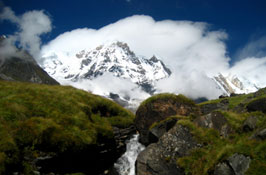
The area hosts everything from two-day
trots to month-long Tolkien-esque odysseys. Of the three major treks, naturally
we chose the odyssey: the Annapurna Circuit – pegged as a challenging but
rewarding three-week affair with the greatest vertical net gain.
The circuit begins in a lush subtropical
valley dotted with farmed terraces and surrounded by rolling mountains
blanketed with coniferous forests. We passed fragrant orchards, bisected a
field of trembling wild marijuana, and crossed churning white rapids on suspension
bridges, pausing to cool off beneath waterfalls that chiselled deep trenches
into the rock face. The landscape gradually opened up to reveal a natural canvas
almost too gigantic to take in, where rock, water and plant competed for
attention. After city life, the air was unbelievably pure, fresh and
oxygenated.
We walked five to seven hours per day,
stopping off to refuel and take shelter at designated teahouses in the frequent
mountain villages en route. This means trekkers don’t need to bring food or
camping equipment. Similarly, porters and guides aren’t really required on the
Teahouses are simple wooden constructions,
offering thin mattresses, clean sheets, and blankets. Trekking is not for
lovers of luxury: ‘Don't expect a hot shower at the end of the day,’ warns
Pretsell. Facilities get increasingly spartan at higher elevations. ‘One toilet
looked like a big coffee tin with a Hessian bag for a door, which faced the
However, stopovers present valuable
opportunities to mix with fellow trekkers, foreign and local – often over a
restorative fix of ‘daal baat’, the Nepali national dish: rice with lentil soup
and vegetable curry, dished up on a metallic tray. (It's a tasty meal, but after about 30
servings ‘Daal baht again?’ became a familiar refrain.) This can be washed down
with a glass of raksi, the local firewater, most memorably sipped round a
log-fired stove in cosy, lamp-lit teahouse kitchens.
Our teahouse encounters engendered a
growing sense of trepidation about the climactic 5,416m (17,768ft) Thorung La summit
pass. Those who had experienced it had tales of endurance to tell, as well as noses
burned red raw. DB told us that the vertiginous 1,600m descent would be even
tougher than the 1,000m dawn ascent. Neither sounded like much fun. Thorung La began
to loom more ominously with each passing day.
Onwards and upwards, though really
trekking in
Most of the locals we encountered seemed genuinely
pleased to see us. Will Gilroy recalls receiving enthusiastic greetings of
‘Namaste (I salute you!)’ from ‘passing porters who were half my height,
wearing old flip-flops and carrying massive cages of live chickens on their
heads’. Children hauled backbreaking loads that would make bodybuilders cringe.
It’s also humbling when a septuagenarian Nepali lady overtakes you, rock-hard calves
pumping her into the distance.
Life in the unaffected, often medieval villages
continues much as it must have for centuries. Eighty percent of the population
still subsists off the land. Farmers use ox-drawn ploughs. Women lay out trays
of chillies to dry in the sun on the doorsteps of boxy stone houses. Firewood is
stacked on flat roofs. The temple
‘It was quite misty on the walk to Manang
[a Tibetan-style village in the
During a rest and acclimatisation day,
Manang seemed to Will to be an outpost of Mordor, the fictional ‘Middle Earth’
lair of evil Sauron in Lord of the Rings. ‘It was dark and overcast, the
town seemed deserted, and I remember hanging off a cliff-face, being blasted by
a really strong wind, and watching eagles swooping over this eerie,
otherworldly place,’ he recalls. ‘It was like nowhere else I’ve ever been. It
felt like we were on our way to
The scenery becomes so cinematic it’s like
taking a walking tour of National Geographic-style exotica. Easy to forget
that, far from being some fabled

None of us managed a wink of sleep before
our day of reckoning; few do above 4,000 meters. Our shared bedroom echoed with
a chorus of coughing, as the three of us struggled to catch breath. A
persistent scratching sound, made by some unseen creature, hardly helped
matters. The seconds ticked down to 4:30am, when we emerged, trembling and
bleary, to start the trudging ascent
The first hour hurt. The climb to Thorung
La is utterly unforgiving. The initial exchanges of snatched, monosyllabic
quips soon gave way to staring at our feet, gasping in the thin, dry air. I
paused every few meters to regulate my breathing, occasionally whispering
self-pitying curses. A dull ache began
to grow in the pit of my lungs. My heart-rate accelerated. I saw a Nepali
porter slip into a waste-deep snowdrift, but could hardly summon the energy to
acknowledge him, let alone help. ‘I ended up vomiting most of the way up,’
admits Chiquita Mitchell.
I started to see moving colours peeking
over the brow of the cliff – and feared my head was about to implode – but,
mercifully, these turned out not to be the hallucinations of advanced AMS but
fluttering prayer flags marking the Thorung La pass! We triumphantly posed for
photos in a spot where the surrounding mountains appeared to be at eye level or
lower.
The descent presented a different kind of
hell. As we edged tentatively down the steep, slushy slope, the cartilage in my
knees seemed to concertina, the tendons running down my shins stiffened then
went into spasms, and my digits were crushed against the toes of my boots. At the
end, we were hobbling like geriatrics with hip replacements.
But as Nepalis say: ‘Ke garne? (What to
do?)’. It was well worth every minute. I reckon you would agree.
Postscript:
-- Published in 2 Magazine, May 2009