Birds of Peace
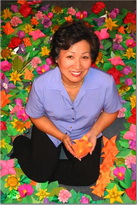
Practised for centuries, Origami has been absorbed into the lifestyles of many Asians, installing an appreciation of style and design into the fabric of their culture. Joel Quenby met a world master of the ancient art.
To some they were a symbol of hope. To others they were a risible waste of time. And to many they just meant a fleeting moment of fun with a sheet of paper. Ultimately they were ineffectual: fresh violence erupted in southern Thailand mere hours after the 120 million-odd origami birds were air-dropped over Narathiwat, Yala and Pattani, in a touching but paper-thin attempt to show solidarity with the locals.
Nonetheless, the “peace bombing” seized the popular imagination. Replica cranes were folded by millions across the kingdom, including the cabinet and the prime minister, who signed his with the promise of a job or a scholarship to its finder.
Cranes also form the theme of Thailand’s first major origami exhibition, hosted this month in the atrium of swanky boutique mall Gaysorn Plaza: the centrepiece display features fifty of the spindly flappers circling a UNICEF globe. It was designed and made by diminutive Japanese-American origami master June Sakamoto, who flew in from America to organise the concept of Gaysorn’s charity fundraiser.
Flying in the face of convention, June, a professional origami artist since 1990, tweaked the centuries-old design for a traditional origami crane, “and developed the flying crane. We flattened it, pulled down the tail and got rid of the hump to make it look more attractive. It’s a little more animated – it’s alive.”
It’s no coincidence that cranes are a reoccurring form in the origami world, though recollecting the poignant story of how they came to symbolise peace and reconciliation brings tears to June’s eyes. Se tells the tale of a young Japanese hibakusha – atom bomb survivor – named Sadako Sasaki, who was two years old during the bombing of Hiroshima.
A decade after the bomb dropped, Sadako contracted leukaemia caused by exposure to radiation; by then the affliction was commonly known among Japanese as “Atom Bomb Disease”. Though there was no cure, thus little hope, for the youngster, friends attempted to cheer her with a legend stating that whoever folds a thousand paper cranes – cranes being auspicious creatures in Japan – will have their wish granted.
In Japanese hospitals, medicine is administered in powder form; Sadako took her plentiful supply of translucent paper drug wrappers and started folding. She got to 644 before she died, in 1955. Her classmates folded the  remainder and she was buried with a wreath of 1,000 cranes.
Sadako’s plight moved her friends to erect a statue of her in the Hiroshima Peace Park: a young girl immortalized in bronze, her hand outstretched, a paper crane flying from her fingertips. “Although this happened 50 years ago,” says June, her voice thick with emotion, “when schools visit Hiroshima they take 1000 cranes with them.
“They all fold one and hang it at the statue; there are thousands and thousands of them. This is why the crane is all-important to me – and it’s not just a piece of paper.”
June is clearly serious about her craft. She established the Project Impace organisation in New Jersey to conduct educational workshops for local schools; and she serves as the executive secretary and exhibition chairperson of OrigamiUSA, for whom she annually designs a unique 14-foot high Origami Christmas Tree, displayed each year at the American Museum of Natural History in New York City.
She’s also translated two origami books from Japanese into English, and even served as an origami ambassador on the Martha Stewart Living< TV show, a month before well-publicised fraud charges were levelled at the entrepreneurial lifestyle guru.
“Martha, in general, was very pleasant,” she recalls. “But I was her guest so she had to be nice. She was very, very strict with her staff – they were tiptoeing around her: ‘Quick, she’s coming!’ I found out that in prison they had a Christmas decoration contest,” says June – who taught Martha how to make a lotus origami on the show. “But she didn’t win.”
Considering her obvious dedication, it’s little wonder June was honoured with the prestigious international “Golden Box Pleat Award” in 2003. The year after that, the US National Origami Organisation awarded her a prize for outstanding service to the community. Even so, June says she’s “a pianist, but not the composer. A creator is someone you can give a piece of paper to and say ‘I want a giraffe with a short neck.’ They’ll be able to do that for you.”
She says that of the top 25 practitioners in the world, only four or five are professionals: earners of an origami-based living. “Unfortunately, like all starving artists, they’re not rich; they’re not living the high life. But their work is fabulous. 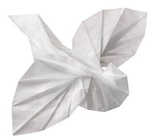
“Some of the top designers are engineers and mathematicians; they’re able to perceive a 3-d object in their mind. If you like crosswords or Rubik’s cubes and mental logic puzzles, you should do very well with origami, because it’s a challenge.”
Indeed, the mathematics of origami have been studied extensively by bird-brained boffins all over. Questions regarding a model's flat-foldability (whether it can be flattened without damaging it) are of grave importance to some. Italian-Japanese mathematician Humiaki Huzita formulated a list of axioms to define origami geometrically. Toshikazu Kawasaki has numerous origami theorems to his name; and has used them to describe paper folding in higher dimensions. Amazing parallels between origami and tessellations have apparently been uncovered. It is used to teach concepts in math, chemistry, physics and architecture.
The mind boggles, but June says: “It seems like magic – and in some cases it is – but it’s really just a matter of step by step, as you’d make a cake.
“It also can be very frustrating: if you just can’t get the legs; or you can’t get enough paper at the top to make the crown. We are not robots; to fold even a crane, which has very set places for the creases, there are days when I fold it over and over because the corners don’t come out right, and I’m in the wrong mood.”  The most difficult model she’s made was a monster lobster, complete with antenna, legs and tail. “It took me three hours,” she says with mock incredulity. “I’m very impatient; I want to see results right away. I could have made 20 other things in that amount of time.”
She relished the challenge of designing origami inspired by a total of 27 luxury brands, from the likes of Burberry and Prada to lingerie specialists La Perla and watchmakers Omega and Swatch. The event organiser’s will auction off an item donated by each brand, along with its complementary origami design mounted in a showcase with proceeds going to UNICEF.
It would seem that in origami June has found her true vocation. Or maybe origami found her. Fittingly, her first ever effort was that classic old standard – no prizes for guessing what – folded at the age of seven. So what hooked her, and turned a potential paper-cut into a lifetime’s occupation?
“It’s a matter of finding what secrets are held in a piece of paper,” she says gently, while deftly manipulating a sheet of paper. I stare at her nimble fingers and puzzle over what form will emerge. “This is why I got involved with origami: I really love to see what happens…” she teases, and a set of cute, puckering paper lips unfurls magically from the creases. “So I made you a kiss!”
-- Published by In Residence, 2005