Encountering Eastern
Spirituality
Millions of people make heartfelt leaps of faith. In
parts of Asia, it sometimes seems mandatory. Occidental travelers
hailing from lands whose mature economies have fed consumer culture for
decades, however, are increasingly secular.
Why is this so?
Western academia has long held that modernity erodes spirituality. Karl
Marx called religion “the opium of the people” back in 1843. Charles
Darwin then pooh-poohed creationism, naturally selecting evolution in
his rationalist bible, On the Origin of the Species (1859). More
recently, Jean-Paul Satre outlined life’s existentialism; and prominent
atheists like Richard Dawkins conceptualized “The God Delusion”, as he
called his 2006 bestseller.
Little wonder many travelers –
including myself – are nonbelievers. However, many of us confess to
enjoying foreign holy heritages. Devout naysayers are regularly
enchanted at the timeless vision of monks placidly padding their alms
rounds. We marvel at bejeweled temples; linger at incense-laden shrines.
Such gilded novelties enrich our travel experiences, rather
than demonstrate abject hypocrisy. I could never be ‘converted’ – but I
once flirted with something akin to a spiritual revelation – on my
maiden voyage to Yangon, Myanmar in 2007.
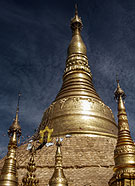
From its hilltop
vantage point, Shwedagon Pagoda is Myanmar’s spiritual talisman. It’s
drawn superlatives from literary greats. Rudyard Kipling called it a
“beautiful winking wonder.” Playwright Somerset Maugham compared the
shrine “glistening with gold, like a sudden hope in the dark night of
the soul.” Aldous Huxley noted the “merry-go-round style of
architecture,” extending his metaphor to the pagoda being “a sort of
sacred fun fair” for pilgrims.
A long-term resident had suggested
a visit “will change your life.” He couldn’t say how – but I was
already sold. I went on my last morning in Yangon.
Historically,
the pagoda has hosted celebrated rallying calls. The morning of my
visit, all was peaceful. Dawn’s rays were starting to fizz off the
mounted golden spire. From the shade of a temple bow, I watched the
faithful circumnavigating the dome on their morning pilgrimages; people
of all ages sharing a reverential, soft-stepping communion. The
mesmerizing ambiance of guttural chanting, punctuated now and again by
the soft clang of prayer bells, created a spine-tingling atmosphere; it
felt like time had paused for a rejuvenating breath.
Presently, I
noticed a lone, twenty-something monk mount the base of the glittering
spire. With special permission from trustees, men may meditate on the
plinth terrace, 6.4m (20ft) above the base. This fellow was aiming
higher, gradually winding round the circular bands forming sloped
transitions to the bell-curved centerpiece.
He continued,
purposefully without hurrying, miraculously finding foot and handholds
where I could see none. He ascended confidently, never pausing to take
stock (or survey what must be a thrilling view over the city). His
steadfast intent suggested he knew exactly where he was going.
(or survey what must be a thrilling view over the city). His
steadfast intent suggested he knew exactly where he was going.
Just
before he reached the sheer-vertical, intricately adorned spire, he
vanished. Suddenly and soundlessly disappeared – was gone – as if
melting into the ether. Had he ascended to Nirvana? Was this divine
intervention? If there’s a discreet antechamber or vertiginous
hidey-hole up there, I’ve never found any reference to it...
To
my side, a couple of the climber’s brethren stared after him visibly
spellbound – judging from their rapt expressions of wonder. It was
strangely reassuring that monks also seemed compelled by the mysterious
vanishing act.
Was it a transformative moment? Had I – like John
Belushi at the altar of James Brown – seen the light? Well, in a word:
No. But it was truly unforgettable; a pleasantly perplexing episode
leaving me with a cherished memory.
In a literary flight of
fancy, Kipling daydreamed that the pagoda spoke, confiding that he had
arrived somewhere “quite unlike any land you know about.”
It was
certainly right.
Unpublished 2010 / Another essay on Scwedagon Pagoda