2005: A Spa Odyssey
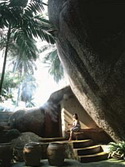
"Leaning against a steamy stone beside a wilting Amanda,
clad in our sarongs but still wearing jewelry, we hunched, Wilma
Flintstone-like, as if waiting for Fred to barge in with a hunk of
dinosaur..." --
The herbal steam room at Tamarind Springs is extraordinary. Set
between two arresting boulders, whose rocky sides serve as walls, it looks
elemental and otherworldly.
I imagine when the prehistoric chimps underpinning human evolution depicted in 2001: A Space Odyssey finished discovering tools, they might have swung somewhere like this to purge themselves of stress-induced toxins. Or perhaps if the New Age druids who flock to Stonehenge on Summer Solstice visited, they'd subsequently shift the stones together to fashion their own mystical sweat-box.
 It’s known locally as the "dragon's cave" - and the
analogy endures: a soporific breathing sound resonates forth as the
herb-infused steam bubbles through pools of water. Meanwhile, the intense
experience of actually sitting in the thing makes one feel like an ingredient bobbing
in a bowl of spicy coconut soup, such
is the zing delivered by the zesty aromas.
It’s known locally as the "dragon's cave" - and the
analogy endures: a soporific breathing sound resonates forth as the
herb-infused steam bubbles through pools of water. Meanwhile, the intense
experience of actually sitting in the thing makes one feel like an ingredient bobbing
in a bowl of spicy coconut soup, such
is the zing delivered by the zesty aromas.
The recipe generating this fug includes beach morning glory - said to clear hangovers and congestion – much like camphor, which is also present, along with lemongrass, tamarind leaf, and kaffir lime, which is known to soothe skin.
Since opening in 1998, this destination spa has reaped
international accolades for its simplicity and holistic dedication.
The journey begins as you turn off the main road to follow a gravel path through a landscaped coconut grove speckled with emerald foliage, lush blossoms, and swaying palm trees to arrive at an idyllic two-storey thatched reception pavilion.
Spa director Ricardo Neuman was on hand to meet me. He regarded
me doubtfully in my rotting jeans - and quickly requested ID.
Springs is reputed for its diligent approach. This became
apparent when Ricardo told me I was lucky the retreat was quiet: journalists
aren't allowed to snoop while guests are being worked on. Most visitors stay
for a few hours, maybe half a day, but there are eight quirky New Age
guesthouses onsite for devotees.
I accepted a suspiciously-hued tamarind and ginger drink while
Ricardo expounded on Springs' ethos. The therapists are all salaried instead of
pounding away for commissions; and they won't chit-chat while conducting a
treatment. Springs' director, Benjamas Pongchababnapa, is vice president of
the Samui Spa Association, a collective which lobbies the government when
sneaky tax-collecting tactics, like a higher charge for establishments offering
customers baths - a measure implemented to penalize bathhouse brothels - impact
upon innocent traditional massage places.
Ricardo's an interesting chap. He practiced massage in
He admitted that while he "can't quite see people's
auras", he had a confirmed  knack for divining for, and easing, people's
"old wounds" - nagging injuries. At one point he tried to demonstrate
how prodding a meridian pressure point on my hand could spark a jolt of
invisible limbic electricity, or something. I wasn't sure about that, but I did
begin to see Ricardo as something of a New Age Mother Therasa wading through a
modern-day battlefield of groaning executives stricken by RSI, healing a horde
of injured with nonchalant massage flourishes.
knack for divining for, and easing, people's
"old wounds" - nagging injuries. At one point he tried to demonstrate
how prodding a meridian pressure point on my hand could spark a jolt of
invisible limbic electricity, or something. I wasn't sure about that, but I did
begin to see Ricardo as something of a New Age Mother Therasa wading through a
modern-day battlefield of groaning executives stricken by RSI, healing a horde
of injured with nonchalant massage flourishes.
We got into a bit of a chinwag about Western science versus natural remedies; how modern medicine can incorporate alternative elements, and that Harvard-trained M.D Andrew Weil is a venerable champion of this "integrated" approach. We touched on how Chinese acupuncture originated from an agonising trial-and-error approach to torture.
I was so taken with all this exotic hocus-pocus that I opted to
sample Ricardo's personal favourite treatment: a two and a half-hour
"prakop" massage, using the Thai tradition of applying a steaming
poultice of aromatic herbs along the body's purported energy lines.
This was a particularly stupid move. I was sunburnt all over
from the previous day, and the last thing my frazzled, tender skin needed was a
steaming poultice. But I was still impressed with the massage. Tamarind Springs
promotes a technique employing slow, strong movements, harnessing the
acupressure and passive yoga that Thai massage is known for, in conjunction
with Swedish influences and deep tissue work.
Massages take place semi-outdoors in a thatched massage sala
offering a pretty view of the landscaped gardens below. Like everything else at
Tamarind Springs, meticulous attention to detail has been invested to make it
that extra bit special. Ricardo was certainly right about his therapists'
sensitivity. The massage contained no painful bits; you’re eased gently into
positions, rather than wrenched.
All that was left for me to do was close my eyes and listen to
the whir of fans fluttering the Tibetan prayer flags overhead, the faint strains
of piped New Age squawking, and the coconut fronds rustling in the sea breeze.
-- Published by In Residence magazine, 2005